Language model experiments
On this page
Research questions
Can recursive computation use a model’s parameters more effectively? Can uncertainty guide how much computation each token needs? Does a coding fine-tune improve completed tasks rather than merely shorten reasoning?
The projects
OSRT-Ostinato investigates sparse recursive transformer architectures. LANTERN explores adaptive computation based on token uncertainty. My coding-model fine-tuning repository covers supervised fine-tuning, preference optimisation and coding-agent evaluation.
How I assess the work
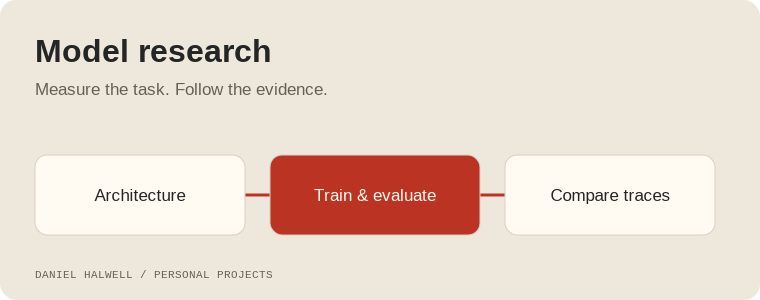
Architecture code, a training run and a useful checkpoint are different results. Comparisons need a named baseline, the same task conditions, complete execution traces and a task-success measure.
Reasoning cost is interesting only alongside quality. A model that uses fewer tokens but fails more tasks is not an improvement for a coding assistant.
Evidence and status
These personal research projects are in progress. The repositories contain architecture implementations, experiment setup and evaluation material for the relevant versions.
Three related experiments
Ostinato investigates repeated decoder blocks and sparse experts. LANTERN asks whether extra recursion should be allocated to tokens that appear uncertain. Coding-model fine-tuning asks whether adapting an existing model improves the work an agent can complete.
These address architecture, inference and post-training respectively. They share an evaluation problem: the extra machinery needs a comparison that isolates what changed.
Adaptive computation in LANTERN
LANTERN reuses a block for a variable number of steps. A shallow pass supplies an uncertainty signal; the generator can then revisit the token with deeper computation and latent pause steps. The repository explores entropy, a probe and changes between recursion-step distributions as signals.
Fixed-depth runs, a matched-compute control and a random allocation control help test whether the signal routes work usefully. A depth-aware cache and equivalent full versus cached decoding are important because an adaptive policy should not accidentally change attention semantics.
Coding-model post-training
Supervised fine-tuning and preference optimisation change a model in different ways. I want the supervised checkpoint to pass a coding-quality comparison before treating additional optimisation as progress. Reference tasks should require execution, meaningful edits and verification rather than rewarding a plausible final explanation.
The training notebook, dataset version, checkpoint identity and task environment belong with the reported result. Keeping those artefacts together makes a regression investigable and prevents a partial run from being mistaken for an accepted model.
What to read next
The public repositories contain architecture implementations, experiment scripts and training material. Their current notes describe version-specific outcomes. This page intentionally keeps the research questions separate from a numerical result, since a number without its baseline and task conditions is difficult to interpret.
The evaluation notebook lays out a small comparison protocol, and Evals are the product connects that protocol to agent applications.