Agent-Gantry & ADAPT-Agent
On this page
The problem
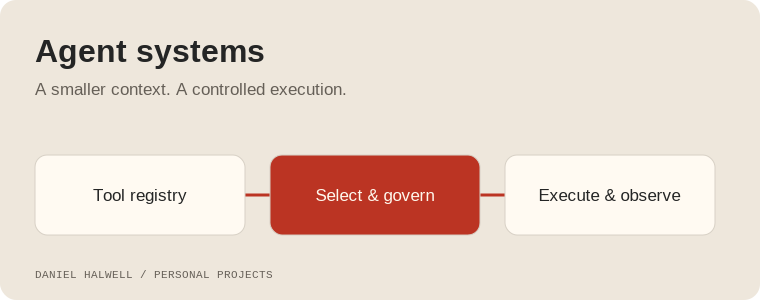
Giving an agent more tools makes discovery and execution harder to reason about. A useful tool description needs to become a provider-compatible schema, a selected action and a controlled execution with observable results.
What I’m building
Agent-Gantry is a Python tool orchestration library with semantic selection, provider schema conversion, controlled execution and MCP / A2A integration. ADAPT-Agent explores policy controls, adversarial detection, taint tracking, evaluation and framework adapters.
Design decisions
Selection and execution are distinct steps. A tool being relevant does not establish that an action is permitted. Policy and data provenance need to survive across calls and framework boundaries.
MCP and A2A support make interoperability practical, while telemetry gives a way to investigate what actually ran.
Evidence and status
Both public repositories include implementation and usage material. The projects explore different parts of the agent infrastructure stack. Their usage material covers the supported interfaces and policy controls.
Explore ADAPT-Agent for its policy and evaluation work.
Agent-Gantry: from catalogue to execution
The tool catalogue is a source of definitions, metadata and callable capabilities. Agent-Gantry retrieves a relevant subset, converts those definitions into the selected provider’s schema dialect, and routes tool calls through its execution layer. This avoids making every model request carry every registered tool.
Its integrations cover MCP in both directions: consuming server tools and exposing a registry to clients. A2A support provides another route for discovering and calling agent capabilities. Retrieval and execution telemetry help explain why a tool was selected and what happened when it ran.
ADAPT-Agent: controls around the call
ADAPT-Agent explores input/output screening, policy enforcement, adversarial detection, taint tracking, observation and evaluation. Framework adapters share a governance pipeline rather than each implementing an unrelated policy wrapper. The CLI can validate configuration and drive evaluations against reference data.
Selection is a relevance decision; execution also needs permission, resource limits and a result that callers can understand. Keeping those stages explicit makes it easier to test a failure at the correct boundary.
A useful integration test
For a small catalogue, I would check that a request retrieves the intended tool, excludes an unrelated action, carries arguments in the right provider schema, and returns a result or a bounded failure. The same test should cover a policy refusal and a timeout. A successful discovery call alone does not establish the execution path.
These are libraries and experiments, with supported interfaces described in their repositories. Pattern-based screening is one component of the system rather than a promise that prompt injection has been solved.
Explore
Read the Agent-Gantry documentation for the tool lifecycle and integrations. ADAPT-Agent’s adapters describe framework wrapping. The infrastructure note explains the reliability questions behind this work.