Shallow Research Code Assistant
On this page
The problem
Research and coding tools often leave a gap between finding information and checking whether the resulting code works. I wanted one workflow that could search, generate Python and run it in an isolated environment.
What I built
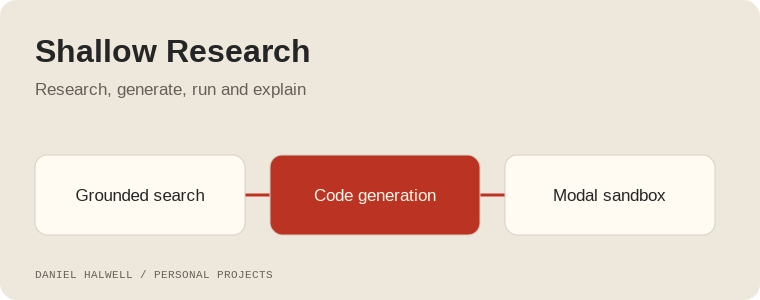
The assistant combines web search, specialised agents, Python code generation and execution in Modal sandboxes. Gradio provides the interface and MCP exposes the capabilities to other clients.
Design decisions
Execution provides evidence about generated code. A separate sandbox makes that execution boundary explicit. MCP lets the research and execution tools participate in a wider agent workflow, while Gradio makes the project directly explorable.
Evidence and status
The public hackathon repository contains the implementation and usage instructions. ShallowCodeResearch received the US$5,000 Modal Labs Choice Award at the Gradio + Hugging Face hackathon in July 2025, also described in my portfolio announcement on LinkedIn.
Explore the source for the Gradio interface, MCP tools and sandbox execution workflow.
The research-to-code loop
The workflow first expands the question enough to guide a search, gathers web evidence, and gives that material to the coding step. The generated Python is checked and executed in a remotely provisioned Modal sandbox. The final response summarises the research and the observed execution result.
Gradio provides a directly usable interface and exposes the capabilities over MCP. That means the same workflow can be called from an MCP-compatible coding client as well as from the project’s UI.
Why execution is part of the answer
A generated script can look correct while failing on an import, assumption or data shape. Running it gives a concrete result to inspect. The sandbox starts with a small scientific Python environment and can install additional dependencies when needed, which also makes environment setup part of the task’s runtime.
Successful execution of one example is still a local result. It does not establish that the research source is correct, that every edge case is handled or that the generated program is suitable for every environment. The trace gives the user a place to make that distinction.
Lessons carried into later projects
The project brings retrieval, generation and execution into one visible workflow. Later work in Codypendent and agent infrastructure gives session ownership, permissions and recovery more explicit roles. The same underlying question remains: what evidence supports the claim that the agent completed the requested work?
Explore the original entry
The hackathon repository contains the Gradio application, MCP connection examples and a recorded demo. Those are the best entry points for understanding the original build and its scope. The award records the hackathon outcome; it is separate from the ongoing development status of my newer tools.